
Intro to Blockchain Without Code is the easiest way for beginners in 2026 to understand that blockchain has evolved from a niche concept into a mainstream topic that industries, governments, and individuals are actively discussing. It’s often linked with cryptocurrencies like Bitcoin and Ethereum, but the truth is that blockchain goes far beyond digital money. It’s a revolutionary way to record information, build trust, and share value in a digital world.
For beginners, blockchain can feel complicated. The technical jargon – like cryptography, consensus, and decentralization – makes it sound like you need years of coding experience to understand it. The good news is you don’t need to be a programmer to learn blockchain. With the right explanations, you can grasp the concepts and see how this technology impacts business, finance, health, education, and even daily life.
This guide is designed for absolute beginners who want to explore blockchain without diving into code. You’ll learn how it works, why it matters, and how industries are already using it today.
As you move through this guide, you’ll gradually build a clear understanding of blockchain fundamentals and discover how the technology operates in real-world situations:
Whenever I explain blockchain to my friends or colleagues who aren’t in tech, I always tell them to ignore the coding jargon and focus on the concept of digital trust. Here is the exact breakdown I use.
- Understand the core idea of blockchain in simple language
- Learn how transactions are stored and verified without coding
- Discover the unique features that make blockchain trustworthy
- Explore real-world uses, from banking to supply chains
- See how blockchain may shape the future of digital life
Blockchain is not just a passing trend. In the same way the internet reshaped communication and commerce decades ago, blockchain is now driving the next big shift in digital innovation. Whether you’re a student, a professional, or someone simply curious about technology, understanding blockchain gives you an advantage in a world that is becoming more digital every day.
So, let’s take the first step together into the world of blockchain – without writing a single line of code.
If you’ve explored free AI tools or learned about boosting productivity with AI at work, this guide will help you connect those innovations with blockchain.
Table of Contents
Intro to Blockchain Without Code: What is Blockchain?
For many, the word ‘blockchain’ immediately sparks associations with Bitcoin and other digital currencies. While digital currencies are the most famous use case, blockchain itself is much broader. To understand it, let’s break it down into simple everyday language without code or complicated math.
Blockchain Without Code Defined in Simple Words
Essentially, a blockchain is a shared digital ledger distributed across many computers in a network. Instead of one company or authority controlling it, the ledger is decentralized, meaning many people (or computers) keep copies of it at the same time.
Think of blockchain as a shared notebook:
- Everyone in a group has a copy.
- When someone writes something new, everyone else’s notebook automatically updates.
- No one can erase or secretly change what’s already written.
This is what makes blockchain powerful: it combines transparency, security, and trust in a digital environment.
Breaking Down the Word: “Block” + “Chain.”
- Block: Think of a block as a digital record, similar to an entry in a ledger that stores transaction details. It stores a group of transactions or records. Once the block is full, it’s sealed.
- Chain: Blocks are digitally tied together in the sequence they appear, forming a tamper-resistant history of information. That’s why it’s called blockchain.
Blocks connect to earlier ones through a distinct digital code, known as a hash, which secures their order. If someone tries to tamper with one block, the whole chain becomes invalid. This makes blockchain extremely resistant to fraud or manipulation.
Example: A Simple Money Transfer
Imagine one person transfers digital tokens to another; for example, Person A sends some cryptocurrency to Person B.
- Person A creates a transaction request.
- The transaction is shared across the blockchain network.
- Computers on the network (called nodes) check whether Person A actually has $10 to send
- After validation, the transaction is recorded inside a new digital block and becomes part of the ledger.
- The block is sealed and connected to the chain, visible to everyone.
The key here is that no bank or central authority is needed to verify this. The blockchain itself handles the trust through its network of participants.
Blockchain Without Code vs. Traditional Database
You might wonder: Isn’t this just another type of database?
Yes and no. A traditional database is stored in one place, controlled by one company (like Google, Amazon, or your bank). Blockchain is different in several ways:
| Feature | Traditional Database | Blockchain |
| Control | Centralized | Decentralized |
| Editing | Records can be changed or deleted | Records are permanent |
| Transparency | Controlled by the owner | Visible to all participants |
| Security | Relies on passwords and firewalls | Relies on cryptography and consensus |
This difference is why blockchain is considered a trustless system – it doesn’t mean it’s untrustworthy, but rather that you don’t have to trust a single authority. The system itself ensures fairness.
Beyond Money: Blockchain Without Code is About Trust
While blockchain started with cryptocurrencies, its true value lies in solving the trust problem in digital interactions. How can two strangers on opposite sides of the world exchange value without relying on banks, governments, or big corporations? Blockchain provides that solution.
Here are some ways blockchain builds trust without coding:
- Immutability: Once written, data cannot be changed.
- Decentralization: No single person or company controls it.
- Transparency: Anyone can verify the records.
- Security: Cryptography ensures records are safe from tampering.
Everyday Analogy: Public Notice Board
Imagine a notice board in a busy marketplace. Anyone can post a message (like “I sold 2 apples to John”). Everyone sees it. No one can erase it. If someone tries to post false information, others in the market will call it out because they also know the truth.
That’s how blockchain works – a public notice board for the digital world, except with strong cryptographic locks.
Why Learn Blockchain Without Code?
Some people avoid blockchain because they think it’s only for coders or math experts. For the majority of readers, grasping the key principles matters for more than diving into technical coding details. You can:
- Use blockchain applications (such as wallets or supply chain trackers) without writing any code.
- Understand industry use cases (finance, healthcare, logistics, voting, etc.)
- Prepare for career opportunities where knowledge of blockchain is valuable.
The good news is, you can take advantage of blockchain without having to develop the underlying system yourself – you just need to know how it works at a high level.
How Blockchain Without Code Works
Now that we understand what blockchain is, let’s take a closer look at how it actually works in practice. Don’t worry – no programming is needed. This guide breaks down blockchain using everyday examples and a simple, progressive approach that anyone can follow.
The Key Ingredients of Blockchain Without Code
A blockchain system runs on a few important components. Imagine it as a recipe: you need all the ingredients to make it work.
- Blocks – These are like containers holding batches of transactions or data.
- Chains – Blocks are connected in order, forming a chain.
- Nodes – Computers that maintain and share the blockchain ledger
- Consensus refers to the process that guarantees every computer in the network reaches the same conclusion about the data.
- Cyptography – Security technology that locks information safely.
When these parts work together, blockchain becomes a secure, transparent, and decentralized digital ledger.
Step-by-Step: How a Transaction Happens
Let’s walk through what happens when someone uses blockchain.
1. A Transaction is Requested
Suppose Sarah wants to send digital tokens to Michael. She creates a transaction using her blockchain wallet.
2. The Transaction is Broadcast
The request is shared across the blockchain network. Every participating computer (node) receives a copy to review.
3. Verification by the Network
The nodes check if Sarah actually owns the tokens she wants to send. They confirm whether her digital signature is valid and whether she has enough balance.
4. Transaction is Grouped into a Block
Once verified, Sarah’s transaction is bundled with others into a block. Think of it as packing several letters into one envelope before mailing.
5. Consensus is Reached
Before a new block is accepted, the connected computers must collectively verify its accuracy, ensuring agreement across the network. Different blockchains use different consensus methods.
6. Block is Added to the Chain
After agreement, the block is permanently attached to the chain. Each block links to the one before it, making tampering nearly impossible.
7. Transaction is Complete
Michael receives his tokens. After a transaction is stored, it’s instantly shared across the network so every participant has the same updated copy of the record.
The Role of Consensus
What sets blockchain apart is its consensus mechanism – an arrangement where the whole community of participants collectively validates the accuracy of the ledger. Without a central authority, how can we ensure fairness? That’s where consensus mechanisms come in.
Common Types of Consensus
- Proof of Work (PoW):
- Computers solve complex puzzles to validate blocks.
- Used by Bitcoin.
- Very secure, but energy intensive.
- Proof of Stake (PoS):
- Participants “stake” (lock up) their coins to validate transactions.
- Used by Ethereum (after its upgrade).
- More eco-friendly than PoW.
- Delegated Proof of Stake (DPoS):
- People vote for delegates who validate transactions on their behalf.
- Faster but slightly less decentralized.
Each method has pros and cons, but the goal is always the same: reach an agreement fairly without needing a central authority.
Why is Blockchain Without Code Secure?
Blockchain is not just about storing data – it’s about protecting it.
- Cryptography: Every block is assigned its own digital code, a hash, which acts as a one-of-a-kind identifier – similar to how no two fingerprints are alike. Changing one detail changes the whole fingerprint, so cheating is easily spotted.
- Distributed Storage: Since thousands of computers store the blockchain, there is no single point of failure.
- Immutability: Once data is added, it can’t be erased or secretly changed.
Together, these features make blockchain much harder to hack than traditional databases.
An Everyday analogy: Shared Google Doc
Think about a Google Document shared among friends:
- Everyone can view updates in real time.
- If one person makes a change, everyone sees it.
- There’s a history log that can’t be erased.
Blockchain is like that Google Doc, except much stronger because it’s not controlled by Google – it’s controlled by everyone in the network.
Where Do Wallets Fit In?
If blockchain is the ledger, then wallets are the tools you use to interact with it.
- A wallet doesn’t actually “store” your coins.
- Rather than holding your funds directly, a wallet keeps your digital keys.
- Your private key acts like a digital signature, allowing you to authorize transactions and confirm that the assets truly belong to you.
This means control lies with the user, not a bank. Lose your key, and you lose access – so wallets are both powerful and risky.
Why This Matters Beyond Tech
Understanding how blockchain works is not just for programmers. It matters because:
- It shows why blockchain is considered trustless yet trustworthy
- It explains how digital currencies function without banks.
- It lays the foundation for new industries like NFTs, decentralized finance (DeFi), and supply chain tracking.
Blockchain represents more than just a technical tool – it introduces a fresh model for how trust and verification can work in communities and economies.
Key Features of Blockchain Without Code
Blockchain is not just another digital system – it is built on unique features that make it stand out from traditional databases or networks. These features are the reason why industries from banking to healthcare are exploring blockchain solutions. The foundation of blockchain rests on three pillars – openness, protection, and independence from central authority.
1. Transparency: Everyone Sees the Same Truth
One of the most revolutionary aspects of blockchain is open visibility.
In a traditional system, records are often hidden on private servers. If you transfer money between banks, you can’t see the internal logs of how it was processed – you just trust the bank. In a blockchain system, every transaction is logged in a shared record that all participants can review and confirm.
Why Transparency Matters
- Trust Without Middlemen: Since all participants can see the same ledger, there’s no need to trust a single authority.
- Auditability: Businesses can prove where their data or money went, without relying on lengthy audits.
- Fairness: Rules are encoded into the blockchain and visible to everyone, reducing opportunities for manipulation.
Real-World Example of Transparency
Imagine buying organic coffee. The seller claims it comes from a specific farm in Colombia. With blockchain supply-chain tracking, you can scan a QR code and see the entire journey of coffee beans – from farmer to roaster to store. That level of transparency builds consumer trust.
2. Security: Protecting Data from Tampering
Blockchain is often described as “tamper-proof.” While no system is 100% perfect, blockchain is designed to be extremely resistant to fraud and hacking.
How Blockchain Without Code Ensures Security
- Cryptographic Hashing:
- Every block has a unique digital fingerprint (hash).
- A tiny alteration in the input instantly generates a totally new hash, signaling that the data has been modified.
- This makes tampering immediately obvious.
- Chain Structure:
- Each block links to the previous one.
- To alter one block, you’d need to change all the blocks after it – a practically impossible task on large networks like Bitcoin.
- Distributed Copies:
- The blockchain is duplicated across a vast network of computers, each maintaining the same synchronized version.
- A hacker would need to attack the majority of them at the same time, which is highly unlikely.
Why Security Matters
- Financial Safety: People trust blockchain to hold billions of dollars in cryptocurrencies.
- Data Integrity: Medical records, legal contracts, and identity documents can be stored without fear of alteration.
- Cybercrime Defense: Decentralized networks are much harder to hack than single-server systems.
3. Decentralization: Power Shared by Many
Most systems we use daily are centralized. Banks control money, governments control IDs, and tech giants control social media. Blockchain flips this model upside down by removing the central authority.
How Decentralization Works
- Instead of one company owning the database, thousands of nodes across the world maintain it together.
- Decisions about updates or rules are made collectively through consensus.
- No single point of failure exists – if one computer goes offline, the network keeps running.
Benefits of Decentralization
- Resilience: If one server fails, the blockchain continues to operate.
- Freedom from Gatekeepers: Anyone can participate in the network without asking permission.
- Equal Power: No single party can quietly change the rules for personal gain.
Analogy: The Town Ledger
Think of a small town where financial records are kept. In a centralized system, one clerk writes everything in a single book. If that clerk makes an error or hides information, no one else knows.
A decentralized setup means that the ledger is duplicated across all participants, ensuring no single point of control. If one book is altered, everyone else notices the discrepancy. That’s blockchain.
The Combined Power of These Features
Transparency, security, and decentralization are powerful individually, but together they create something much more valuable: trust without intermediaries.
- In finance, this means sending money across the globe without banks.
- Within healthcare, it could allow individuals to manage and grant access to their own encrypted medical records safely.
- Applied to governance, blockchain can enable open voting systems where results are transparent and resistant to hidden manipulation.
Challenges to Keep in Mind
Of course, these features also come with challenges:
- Transparency vs. Privacy: While visibility is good, some industries (like healthcare) need to balance openness with confidentiality.
- Security Costs: Systems like Proof of Work require high energy use to maintain security.
- Decentralization Efficiency: Without a central authority, decisions can take longer, and scaling can be harder.
The good news is that new blockchain models are actively working to solve these issues, blending innovation with practicality.
Why These Features Make Blockchain Without Code a Game-Changer
In stripping blockchain down to its essence, these three features are what set it apart from any other system we’ve had before:
- Transparency ensures honesty.
- Security ensures data integrity.
- Decentralization ensures fairness.
Together, they create a system where strangers can collaborate, trade, and build without needing blind trust in third parties.
This is why blockchain is being called one of the most disruptive technologies of the century.
For more, check IBM Blockchain.
Types of Blockchain Without Code: Public, Private, Hybrid, and Consortium
While blockchain is often referred to as a single technology, there are actually multiple types of blockchain. Over the years, developers have created various models to cater to different needs. Some are open to everyone, while others are designed for closed groups or industry collaborations.
Understanding the types of blockchain is crucial because each comes with its own strengths, weaknesses, and ideal use cases. The four main types are:
- Public Blockchain
- Private Blockchain
- Hybrid Blockchain
- Consortium Blockchain
Let’s break them down one by one.
1. Public Blockchain
In a public setup, the network remains accessible to everyone, encouraging transparency and wide participation without central control. Anyone, anywhere in the world, can join, read, write, and participate in the network. Bitcoin and Ethereum are the most famous examples.
Key Features
- Accessibility: Any person with internet access can participate without needing approval.
- Decentralized Control: No single authority manages the network.
- Complete Transparency: All activities are permanently recorded in a shared ledger that everyone can see.
- Validation Process: Most public chains rely on methods like Proof of Work (PoW) or Proof of Stake (PoS) to confirm transactions.
Advantages
- Trust-Free Model: The system works without depending on a single authority for verification.
- Strong security: Hacking is extremely difficult due to global distribution.
- Innovation-friendly: Developers can build decentralized applications (dApps) freely.
Challenges
- Slower transaction speeds compared to private systems.
- Energy-intensive (especially with PoW)
- Not always suitable for industries that require strict privacy
Use Cases
- Cryptocurrencies (Bitcoin, Ethereum).
- Open-source financial services.
- Decentralized voting platforms.
2. Private Blockchain
In contrast to open networks, private blockchains restrict participation and require explicit permission. Only selected participants can join, and usually, one organization has control over the network.
Key Features
- Restricted Access: Only invited users can participate.
- Governance: Rules and operations are managed by one designated organization or entity.
- Faster Transactions: Smaller networks allow quicker verification.
- Custom Privacy Levels: Transactions can be hidden from non-members.
Advantages
- Speed and efficiency: Without thousands of nodes, transactions are confirmed quickly.
- Privacy: Ideal for businesses dealing with sensitive data.
- Flexibility: Rules and permissions can be tailored to organizational needs.
Challenges
- Centralization risks: More vulnerable to corruption or tampering.
- Lower trust: Users must trust the authority running it.
- Limited innovation: Access is restricted to members.
Use Cases
- Banking systems for internal settlement.
- Supply chain management within a company.
- Enterprise record management (HR, finance, legal).
3. Hybrid Blockchain
A hybrid blockchain mixes features of open public networks and restricted private ones, offering flexibility by combining transparency with selective control. It allows organizations to keep some data private while making other parts publicly accessible.
Key Features
- Dual Nature: Combines permissioned access with public transparency.
- Customizable Privacy: Sensitive data can remain private, while proof of integrity can be shared on a public chain.
- Scalability: Offers flexibility to grow with organizational needs
Advantages
- Balanced privacy transparency.
- Efficient performance with customizable openness.
- Ideal for industries needing both security and accountability.
Challenges
- Complexity in setup and management.
- Potential governance issues when combining models.
- Certain parts of a hybrid chain may still depend on an overseeing organization to handle key functions.
Use Cases
- Healthcare: Patient data remains private, but treatment records can be verified publicly.
- Cross-border payments: Private settlements with public proof of transactions.
- Retail: Internal supply-chain details stay private, while consumers see product authenticity publicly.
4. Consortium Blockchain
A consortium blockchain (sometimes called a federated blockchain) is managed by a group of organizations instead of just one entity. This model acts as a compromise between completely open systems and fully restricted ones.
Key Features
- Group Governance: Multiple organizations collectively manage the network.
- Restricted Validation: In consortium blockchains, only approved members are allowed to confirm transactions.
- Shared Responsibility: Power is distributed across known participants.
Advantages
- Collaboration: Multiple parties work together without total centralization.
- Efficiency: Transactions are faster than public blockchains.
- Trust: Organizations hold each other accountable.
Challenges
- Requires cooperation: Members must align on goals and rules.
- Partial decentralization: Not as open as public blockchains.
- Vulnerable to insider conflicts.
Use Cases
- Trade and shipping alliances.
- Banking groups are creating shared settlement platforms.
- Energy companies are coordinating shared infrastructure.
Comparing the Four Types of Blockchain
| Type | Access | Control | Transparency | Speed & Efficiency | Ideal For |
| Public | Open to all | No central authority | Very high | Slower | Cryptocurrencies, open dApps |
| Private | Restricted | One organization | Low (private) | Very fast | Enterprises, internal operations |
| Hybrid | Mixed | Semi-centralized | Balanced | High | Healthcare, retail, payments |
| Consortium | Group-based | Multiple organizations | Moderate | Fast | Industry alliances, trade finance |
Choosing the Right Blockchain Without Code Type
The ideal type of blockchain varies based on what the project is trying to achieve and the problems it aims to solve:
- If openness and decentralization are top priorities –> Public Blockchain
- If speed and privacy matter more, –> Private Blockchain
- If you want both transparency and privacy –> Hybrid Blockchain
- If multiple organizations must collaborate, –> Consortium Blockchain.
There’s no “one size fits all.” That’s why industries experiment with different models depending on their needs.
Final Thoughts on Blockchain Types
The diversity of blockchain types shows how flexible the technology is. From open global networks to private corporate systems, blockchain can adapt to almost any context.
The choice of blockchain type shapes how secure, transparent, and scalable a project will be. By understanding these four models, individuals and organizations can make smarter decisions about where and how to apply blockchain effectively.
How Blockchain Without Code is Used Across Industries
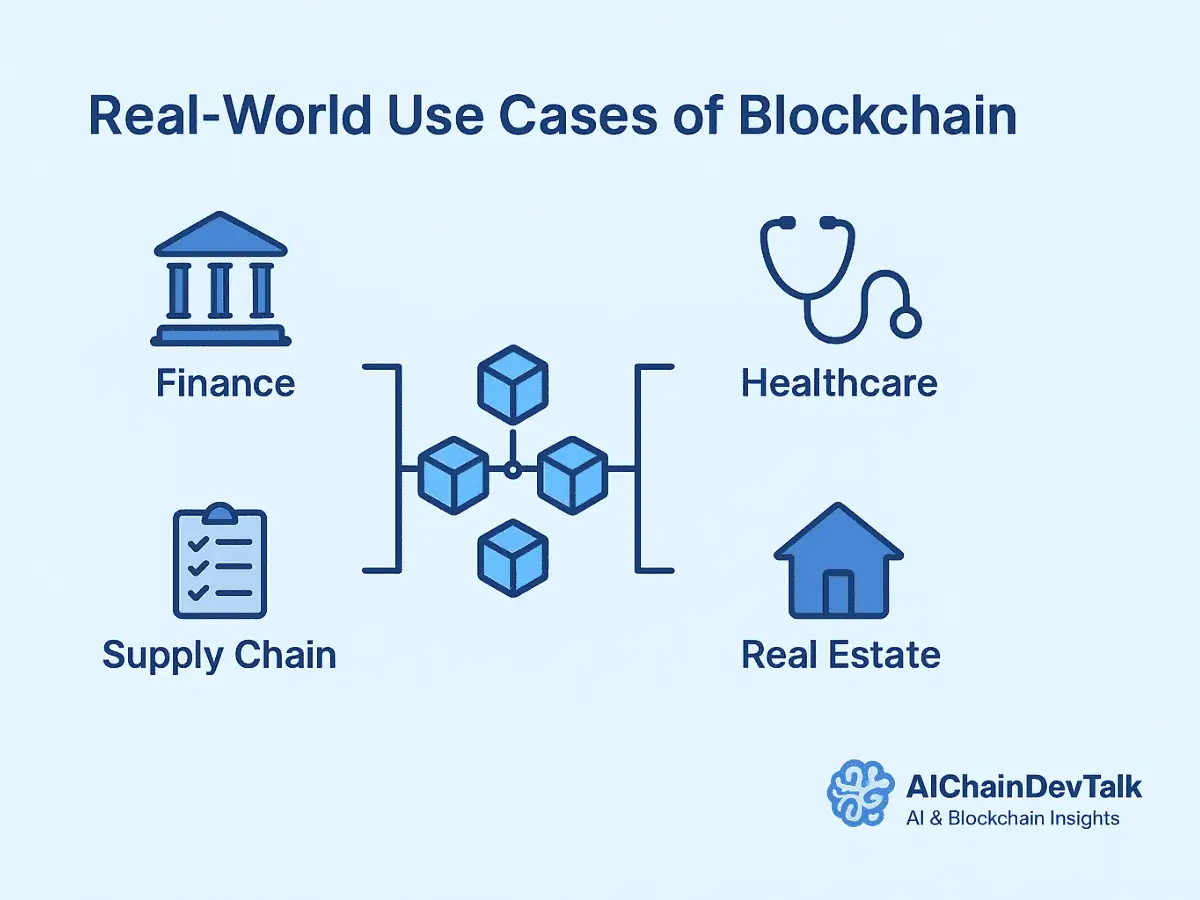
Blockchain is not just about Bitcoin or cryptocurrencies. Over the past decade, the technology has found applications across multiple industries, solving problems related to trust, transparency, speed, and security. From banking and healthcare to retail and government, blockchain is reshaping how organizations handle data and transactions.
Let’s explore some of the biggest industries where blockchain is making an impact.
1. Finance and Banking
The financial sector was one of the first industries to embrace blockchain because it directly deals with money, trust, and verification.
How Blockchain Without Code Helps in Finance
- Speeding up payment. Conventional cross-border transfers may take several days, while blockchain enables near-instant settlement. With blockchain, settlements can happen in minutes.
- Fraud Prevention: Since every transaction is locked permanently into the ledger, it becomes extremely difficult for bad actors to manipulate or falsify data.
- Lower Costs: By cutting out intermediaries, banks save on transaction fees and administrative costs.
Real-World Examples
- Ripple (XRP): Helps banks process international payments quickly.
- JPMorgan developed its Onyx system to enable faster and more secure interbank transfers by using blockchain as the settlement The global shipping giant Maersk has experimented with its TradeLens platform.
2. Healthcare
In healthcare, data privacy and accuracy are critical. Patient records are often scattered across hospitals and clinics, leading to inefficiency and risk of errors.
How Blockchain Without Code Helps in Healthcare
- Unified Patient Records: A secure, tamper-proof ledger ensures medical history is accessible across different providers.
- Drug Traceability: Prevents counterfeit medicines by tracking supply chains.
- Clinical Trials: Ensures transparency in trial data and reduces manipulation.
Real-World Examples
- MediLedger: Tracks pharmaceuticals to fight counterfeit drugs.
- BrustlQ: Provides a blockchain-based platform for managing healthcare data securely.
3. Supply Chain and Logistics
Supply chains often span multiple countries, involving manufacturers, shippers, distributors, and retailers. This complexity makes it difficult to track goods efficiently.
How Blockchain Without Code Helps in Supply Chains
- Complete traceability: Blockchain logs each stage of a product’s movement, from origin to customer.
- Reduced Fraud: Prevents fake products from entering the market.
- Faster Operations: Cuts down paperwork and delays in customs or shipping.
Real-World Examples
- IBM Food Trust: Tracks food products from farm to table, improving safety and traceability.
- Maersk introduced the TradeLens initiative to bring shipping paperwork onto blockchain, making cargo tracking and customs processes more transparent and efficient.
4. Real Estate
Property deals often move at a sluggish pace, involve endless paperwork, and are prone to conflicts or fraudulent activity.
How Blockchain Without Code Helps in Real Estate
- Smart Contracts: Automate sales agreements and payments.
- Land Registry: Tamper-proof digital records prevent ownership disputes.
- Fractional Ownership: Blockchain allows tokenizing real estate, so investors can own part of a property.
Real-World Examples
- Propy: A blockchain-based platform for global property transactions.
- Ubitquity: Provides blockchain-powered land and title record management.
5. Government and Public Services
Governments manage vast amounts of data – from identity to voting systems. Blockchain can increase transparency and reduce corruption.
How Blockchain Without Code Helps in Governance
- Digital Identity: Secure, verifiable IDs for citizens.
- Voting Systems: Transparent, tamper-proof elections.
- Government registries such as property deeds, tax filings, and licenses can be securely stored on blockchain.
Real-World Examples
- Estonia’s e-Government: Uses blockchain for digital identity and e-services.
- Voatz (USA): Experimented with blockchain-based mobile voting.
6. Retail and E-Commerce
Online shopping is booming, but issues like fake products and a lack of transparency remain.
How Blockchain Without Code Helps in Retail
- Authenticity Checking: Buyers can trace an item’s origin on the blockchain, ensuring that what they purchase is original and not counterfeit.
- Loyalty Programs: Tokens can replace traditional reward points.
- Faster Payments: Supports instant crypto payments globally.
Real-World Examples
- Walmart: Tracks food products on blockchain for better safety.
- VeChain: Provides blockchain solutions for verifying product authenticity.
7. Energy and Sustainability
The energy sector is shifting toward renewable sources, and blockchain helps manage distributed systems.
How Blockchain Without Code Helps in Energy
- Neighborhood energy sharing: Households producing surplus solar power can trade it directly with others in their community.
- Carbon Tracking: Companies can prove eco-friendly practices by recording emissions data.
- Grid Management: Helps manage decentralized energy systems efficiently.
Real-World Examples
- Power Ledger (Australia): Enables peer-to-peer energy trading.
- The Energy Web initiative develops blockchain-based systems that support renewable energy trading and management across global markets.
8. Education
Education systems face challenges with credential verification, student data storage, and accessibility.
How Blockchain Without Code Helps in Education
- Diplomas and Certificates: Stored on blockchain to prevent forgery.
- Student Records: Secure, easily transferable across institutions.
- Learning Platforms: Token-based systems for rewarding participation.
Real-World Examples
- MIT Media Lab: Issues digital diplomas via blockchain.
- Sony Global Education: Uses blockchain for secure data sharing.
9. Entertainment and Media
Copyright infringement, piracy, and unfair payment distribution are common in creative industries.
How Blockchain Helps in Media
- Fair Royalty Payments: Smart contracts ensure artists get paid automatically.
- Content Protection: Prevents unauthorized copying or sharing.
- Direct Creator-to-Fan Models: Reduce reliance on middlemen like streaming platforms.
Real-World Examples
- Audius: A decentralized music streaming platform.
- Theta Network is an example from the media industry, where blockchain supports decentralized video delivery and offers token-based incentives to viewers and creators.
10. Insurance
Insurance involves complex contracts and claims, which often suffer from fraud or delays.
How Blockchain Helps in Insurance
- Smart Contracts: Automate claim processing when conditions are met.
- Fraud Detection: Immutable records make it harder to submit false claims.
- Reinsurance: Improves data sharing among insurers.
Real-World Examples
- Etherisc: Uses blockchain for decentralized insurance products.
- B3i, short for Blockchain in Insurance Initiative, is a collaborative group of insurers testing blockchain-based tools for the industry.
Final Thoughts on Blockchain Without Code in Industries
Blockchain is no longer just an experimental technology. Its applications are real, diverse, and growing across industries.
- Finance is speeding up global transactions.
- Healthcare is improving patient safety.
- Supply chains are becoming more transparent.
- Governments are increasing trust in services.
The growing number of industries adopting blockchain shows that it has moved beyond hype and is establishing itself as a lasting innovation. It is becoming part of the infrastructure that underpins the digital economy.
Where Blockchain Without Code Is Heading: Key Obstacles, Emerging Possibilities, and Future Directions
Blockchain has already proven its potential across multiple industries, but the journey is far from complete. While adoption is growing, the technology still faces scalability, regulation, energy, and usability challenges. At the same time, new opportunities like Web3, NFTs, CBDCs (Central Bank Digital Currencies), and AI-blockchain integrations are shaping its future.
In this section, we’ll explore what lies ahead for blockchain: the hurdles it must overcome, the opportunities on the horizon, and the trends that could define the next decade.
Key Challenges Facing Blockchain Without Code
Even though blockchain has captured global attention, several obstacles prevent it from reaching mass adoption.
1. Scalability
Most blockchains, especially early ones like Bitcoin and Ethereum, struggle with handling large volumes of transactions quickly. For example:
- The Bitcoin network currently handles only about seven transactions each second, which limits its ability to scale globally.y..
- Ethereum manages ~30 TPS, though upgrades like Ethereum 2.0 are improving this.
In comparison, Visa handles over 65,000 TPS. Without breakthroughs in scalability, blockchain cannot serve as a complete substitute for existing financial and data systems.
2. Energy Consumption
Some blockchains, particularly those using Proof of Work (PoW), consume huge amounts of electricity. The energy-intensive process of Bitcoin mining has drawn widespread criticism due to its heavy environmental footprint. Solutions like Proof of Stake (PoS), layer-2 scaling, and green energy mining are being developed to reduce this.
3. Regulatory Uncertainty
Across the globe, regulators are still drafting policies on digital assets like cryptocurrencies, NFTs, and blockchain-driven enterprises. This lack of clarity created fear among investors and startups.
- Some countries (like Switzerland and Singapore) welcome blockchain innovation.
- Others (like China) have banned crypto mining and trading.
Clear, fair regulations are necessary for blockchain to grow without misuse.
4. Interoperability
There are thousands of blockchains today, but most don’t talk to each other. This creates “islands” of data. Projects like Polkadot, Cosmos, and Chainlink aim to improve cross-chain communication, but interoperability is still a challenge.
5. Usability and Adoption Barriers
For non-technical users, blockchain is still intimidating. For newcomers, managing wallets, understanding private keys, and dealing with transaction fees can feel overwhelming. Until blockchain becomes as easy as using an email app, mass adoption will remain slow.
Opportunities Ahead for Blockchain
Despite the challenges, blockchain has huge opportunities waiting to be unlocked.
1. Web3 and Decentralized Internet
Web3 marks a new phase of the internet in which individuals maintain control of their personal data rather than surrendering to large corporations. This vision is supported by blockchain, which lets people manage their own digital identities, assets, and online interactions.
- Decentralized apps (dApps) will replace traditional apps.
- DAOs (Decentralized Autonomous Organizations) allow communities to govern projects without central authority.
2. Central Bank Digital Currencies (CBDCs)
Governments worldwide are exploring digital currencies built on blockchain
- China is piloting the Digital Yuan.
- The European Union is researching a Digital Euro.
- Dozens of central banks are testing CBDCs.
CBDCs could make payments faster, reduce banking costs, and bring financial inclusion to millions.
3. NFTs and the Creator Economy
NFTs, first popularized through digital artwork, are rapidly expanding into many other practical applications:
- Gaming: Players can truly own in-game assets.
- Music and Media: Artists can sell directly to fans, avoiding middlemen.
- In industries like ticketing and real estate, NFTs provide a way to confirm authenticity and minimize fraud risks.ks
NFTs represent a broader tokenization of real-world assets, which could transform how we buy, sell, and trade value.
4. Blockchain and Artificial Intelligence (AI)
AI and blockchain together could create powerful systems:
- AI models verified on blockchain: Ensures transparency in training and results.
- Decentralized AI marketplaces: People could buy and sell AI services without Big Tech monopolies.
- Data ownership for AI: Users could control and monetize their own data for AI training.
5. DeFi 2.0 (Decentralized Finance Evolution)
DeFi (decentralized Finance) has already shown how lending, borrowing, and trading can happen without banks. The next wave, DeFi 2.0, focuses on:
- Better security (fewer hacks).
- Stable growth (avoiding pump-and-dump cycles).
- Institutional adoption (banks and funds using DeFi).
6. Sustainable and Green Blockchain
As climate concerns grow, projects that prove they are eco-friendly will dominate. Proof of Stake (PoS) systems, carbon-neutral mining, and renewable energy-powered blockchains are gaining traction.
Emerging Blockchain Trends to Watch
The next decade could see blockchain become as common as email or social media. Some trends to watch include:
- Metaverse Integration – Blockchain will power virtual assets, real estate, and economies inside metaverses.
- Tokenization of Everything – From stocks and bonds to art and property, almost any asset could be tokenized.
- Identity on Blockchain – Digital IDs stored securely on-chain will replace physical documents like passports and licenses.
- Smart Cities – Governments may use blockchain for utilities, voting, and urban planning.
- Decentralized Cloud Storage – Platforms like Filecoin and Storj will compete with Google Drive and Dropbox.
The Road Ahead
Blockchain is at the same stage the internet was in the early 1990s – full of potential, but still developing. Back then, many doubted that email or online shopping would become mainstream. Today, we can’t imagine life without them. Blockchain could follow a similar path.
In the short term:
- Expect more blockchain startups, especially in DeFi, NFTs, and Web3.
- Regulations will shape how crypto and blockchain evolve.
- Companies will test small blockchain projects before full adoption.
In the long term:
- Blockchain could become the invisible infrastructure powering finance, healthcare, energy, and even government.
- Just like we don’t think about TCP/IP when using the internet, people won’t need to know how blockchain works – it will simply work in the background.
Final Thoughts
Blockchain is not just a buzzword. It is a transformative technology with the potential to reshape industries, redefine trust, and give power back to individuals.
- The challenges – scalability, energy, regulations, and usability – are real, but solvable.
- The opportunities – Web3, NFTs, CBDCs, and AI integrations – are vast and exciting.
- The future belongs to those who can innovate responsibly while ensuring accessibility and sustainability.
We are witnessing the early stages of a digital revolution that will impact how we work, interact, and live. The key for businesses, governments, and individuals is to stay curious, keep experimenting, and adapt to this evolving landscape.
Gotta love those lucky numbers! 777xk’s design is pretty sharp. Just hoping it translates to winning big time. Worth a peek, eh? Head over here: 777xk
Thanks! Glad you like the design 😊 Fingers crossed it brings some lucky wins too!