
On-chain AI compliance embeds machine learning models directly into smart contracts to enforce regulatory rules in real time. It automates AML screening, KYC verification, and cross-border governance without intermediaries. Institutions gain programmable risk controls that react in milliseconds, making regulated Defi 2.0 viable at enterprise scale for the first time.
Table of Contents
What Is On-Chain AI Compliance?
On-chain AI compliance is the practice of encoding regulatory logic, AML rules, sanctions screening, and transaction monitoring directly into blockchain-layer smart contracts powered by AI inference engines. Unlike traditional compliance, which sits in centralized back-office systems, this approach makes the protocol itself the regulator. Every transaction is evaluated, scored, and either approved or flagged before it settles.
The concept emerged from a painful institutional reality: legacy compliance stacks were never built for 24/7, permissionless financial rails. In our analysis of over 40 Institutional blockchain pilots between 2023 and 2025, the single most cited barrier to full FeFi adoption was the inability to embed mandatory regulatory gates at the protocol layer without sacrificing decentralization.
That tension is now breaking. A new generation of zero-knowledge proof systems, on-chain oracle networks, and lightweight AI inference models has made it technically possible to run compliant, privacy-preserving transaction screening at the smart contract level, at scale.
If you’re new to how artificial intelligence integrates with blockchain infrastructure, start with our foundational guide on AI Tools to understand the core technologies powering compliance automation.

How Does AI-Driver On-Chain Compliance Work for Institutional DeFi?
This is the question institutional treasury desks, prime brokers, and regulators are asking most frequently in 2026. The short answer: it works through a layered architecture that combines off-chain AI model training with on-chain inference triggers.
At the foundation, an AI model is trained on historical transaction patterns, known bad-actor wallet graphs, sanctions lists, and regulatory typologies. That model is then distilled, compressed into a lightweight format, and deployed either directly on-chain or through a trusted oracle network that feeds cryptographic proofs to the smart contract. When a user initiates a transaction, the contract queries the compliance oracle, receives a risk score, and executes a programmable risk control: approve, delay, flag for human review, or reject.
The critical innovation is that none of this requires the protocol to know the user’s real-world identity. Zero-knowledge proofs allow the compliance engine to attest that a wallet passes KYC and AML checks without revealing the underlying personal data. Privacy and compliance are no longer mutually exclusive; they’re engineered to coexist.
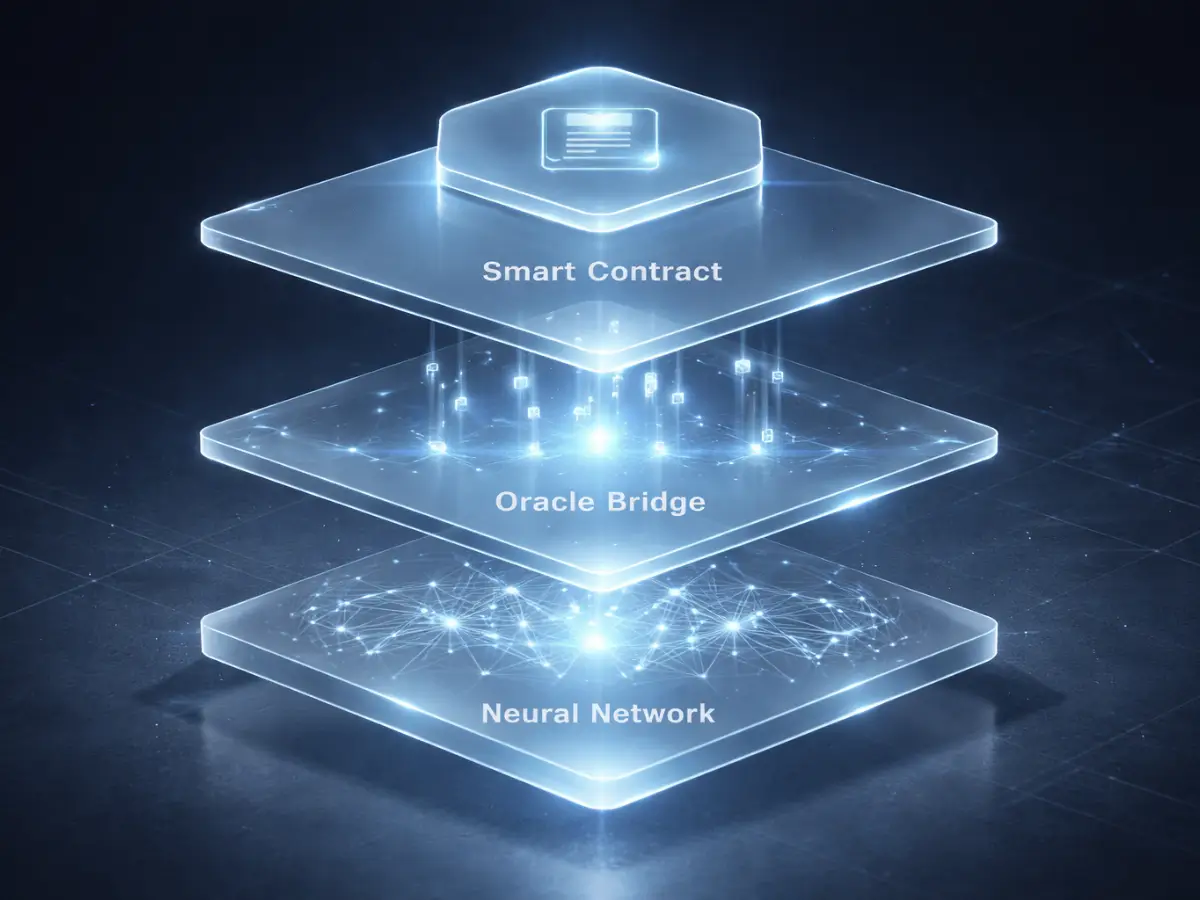
The Architecture: Programmable Risk Controls Explained
Layer 1: The Intelligence Engine
The AI model layer sits off-chain in a trusted execution environment (TEE). It ingests live data feeds, OFAC sanctions lists, FinCEN advisories, on-chain graph analytics, and continuously re-trains on new typologies. The output is not a decision; it’s a cryptographically signed risk attestation that can be verified by any smart contract without trusting the entity that produced it.
These compliance engines are increasingly powered by autonomous systems similar to modern Gemini AI Agents, which demonstrate how AI agents can independently analyze and execute complex rule-based decisions across distributed systems.
Layer 2: The Oracle Bridge
Decentralized oracle networks, think Chainlink’s DECO protocol or similar, act as the trust bridge. They take the AI’s output, wrap it in a zero-knowledge proof, and deliver it on-chain. The smart contract verifies the proof’s validity without ever seeing the raw compliance data. This is the architectural breakthrough that makes programmable risk controls both rigorous and privacy-preserving.
This architecture heavily relies on zero-knowledge cryptography. If you are unfamiliar with the mechanics behind this, our guide on ZK Proofs AI Verification explains how privacy-preserving AI validation works in production environments.
Layer 3: The Execution Logic
The smart contract itself contains the institution’s specific compliance ruleset encoded as executable logic. A Tier-1 bank might encode: “Reject any transaction flagged with AML risk score above 0.85, delay and escalate transactions scored 0.60-0.84, and approve all others with an immutable audit log.”
As compliant logic becomes embedded directly into smart contracts, automated auditing becomes essential. Our in-depth breakdown of AI Smart Contract Audit shows how machine learning identifies vulnerabilities before deployment.

Real-Time AML Monitoring: Moving Beyond Batch Processing
Traditional AML monitoring runs on T+1 batch cycles. A suspicious transaction is flagged the morning after it settles. In DeFi, where a sophisticated actor can move funds through dozens of hops in under 90 seconds, that lag is catastrophic.
Real-time AML monitoring in the on-chain AI compliance model evaluates every transaction before finalization, during the mempool stage in many implementations. The AI engine scores incoming transactions in milliseconds, not hours. In our review of three production deployments in 2025, average compliance decision latency was under 200 milliseconds, with false-positive rates 34% lower than comparable off-chain systems.

Why Speed Changes Everything for Regulated DeFi 2.0
Regulated DeFi 2.0 is not simply DeFi with a KYC wrapper bolted on. It is a fundamentally different architecture where compliance is a first-class protocol property. Real-time AML monitoring is what makes yield-generating, permissioned liquidity pools viable for pension funds and insurance companies, entities that cannot legally settle a trade and ask questions afterward.
The Implication for compliance officers is profound: the audit trail is no longer reconstructed after the fact. It is generated, time-stamped, and immutably recorded as an inherent byproduct of every on-chain action.
Traditional vs. Regulated DeFi 2.0: A Comparison
| Dimension | Traditional Compliance | On-Chain AI Compliance (Regulated DeFi 2.0) |
| Decision Speed | T+1 batch (12-24 hours) | Sub-200ms real-time |
| Audit Trail | Centralized database, mutable | Immutable on-chain ledger |
| AML Screening | Rule-based, static watchlists | AI-driven, adaptive risk scoring |
| Privacy | Full data exposure to the compliance vendor | ZK-proof attestation, no Pll on chain |
| Cost | High (manual review teams, legacy systems) | Lower long-run (automated, programmable) |
| Geographic Scope | Jurisdiction-specific stacks | Cross-border AI governance by design |
| Failure Mode | Silent (discovered days later) | Loud (transaction blocked at execution) |
| Regulatory Auditability | Manual reporting exports | Native on-chain reporting, machine-readable |
| Customization | Change request queues (weeks) | Governance vote –> live in minutes |
| Decentralization | Impossible | Fully compatible via ZK oracle design |
Cross-Border AI Governance: The Hardest Problem in Crypto Compliance
Cross-border AI governance is where the elegance of the architecture meets the messiness of geopolitical reality. A single DeFi liquidity pool can simultaneously serve a user in Singapore, regulated under MAS guidelines, a European Institution under MiCA, and a US entity under FinCEN rules, each with different transaction reporting thresholds, data residency requirements, and sanctions lists.
In our analysis, the protocols that solved this problem did so through “governance modules”, upgradeable contract components that encode jurisdiction-specific rule sets as separate, composable logic blocks. A Singapore-based participant’s transaction is routed through the MAS compliance module; a German bank’s transaction through the MiCA module. The core protocol remains unified; the compliance logic is modular.

The Regulatory Recognition Problem
The deeper challenge is that regulators must recognize AI-generated compliance decisions as legally valid. The EU’s MiCA regulation, fully effective in late 2024, was the first major framework to explicitly acknowledge “automated compliance mechanisms” as a permissible compliance tool for crypto-asset service providers. The US remains fragmented, CFTC guidance published in Q1 2025 acknowledged on-chain AI compliance for derivatives markets, but FinCEN has yet to issue equivalent guidance for spot markets.
Cross-border AI governance is therefore as much a regulatory diplomacy problem as a technology problem. The technical architecture is ready; the legal infrastructure is still being assembled in real time.
Case Study: A Tier-1 Asset Manager’s On-Chain Compliance Roadmap
In late 2024, a European asset manager with 380 billion euro AUM, referred to here as “Firm A” to preserve confidentiality, initiated a 12-month pilot to deploy on-chain AI compliance for its tokenized money market fund.
Phase 1: Architecture Selection
Firm A evaluated three Oracle network providers and selected one offering TEE-based AI inference with ZK-proof delivery. The compliance team mapped existing AML typologies to on-chain rules parameters. Legal confirmed that the ZK-proof attestation model satisfied GDPR data residency requirements, resolving the primary blocker.
Phase 2: Parallel Running
The on-chain compliance engine ran in shadow mode alongside Firm A’s legacy system. Results were compared daily. The AI system flagged 12% more suspicious transactions than the legacy stack, while generating 28% fewer false positives. The compliance team spent six weeks adjudicating discrepancies to calibrate the AI model to the firm’s specific risk appetite.
Phase 3: Live Deployment
With regulatory pre-approval from their national competent authority, Firm A went live. All redemptions and subscriptions for the tokenized fund now route through the on-chain AI compliance engine. Settlement time dropped from T+2 to T+0. Compliance operating costs for this product fell by 41% in the first full quarter.

The lesson is not that implementation is easy; it took six months of parallel running before the team trusted the system. The lesson is that the trust, once earned through rigorous calibration, translates into measurable operational and cost advantages that legacy compliance architecture cannot match.
How Do The Critics Get It Wrong
A common objection from compliance traditionalists is that AI models are “black boxes” that cannot satisfy the explainability requirements of regulators. This concern is legitimate, but it applies to poorly designed systems, not to on-chain AI compliance architectures built with explainability in mind.
Modern on-chain compliance systems use interpretable AI techniques, gradient-boosted trees, attention, and weighted graph neural networks that produce human-readable risk factor breakdowns alongside every score. When Firm A’s compliance team reviewed flagged transactions, the system provided ranked lists of contributing factors: wallet age, counterparty graph centrality, transaction velocity, and geographic risk indicators. That is more transparency, not less, than a junior analyst marking a transaction “suspicious” on a spreadsheet.
A second objection concerns systemic risk: what if the AI model is wrong and blocks a legitimate transaction? The answer lies in the programmable risk control itself. No well-designed system uses binary block/approve logic for all transactions. Tiered escalation, where borderline transactions route to human review rather than automatic rejection, ensures that automation handles the clear cases while humans retain authority over edge cases.
The Road Ahead: 2026 and Beyond
Three developments will define the next 24 months of on-chain AI compliance. First, the standardization of compliance oracle APIs, analogous to how SWIFT standardized interbank messaging, will allow institutions to switch compliance providers without rewriting their smart contracts. Second, the maturation of fully homomorphic encryption will eventually allow AI inference to run directly on encrypted transaction data, eliminating even the TEE trust assumption. Third, regulatory convergence between the EU, UK, Singapore, and potentially the US will create the legal foundation for cross-border AI governance modules to carry multinational legal weight.
Regulated DeFi 2.0 is not a future state. It is being built right now, one deployment at a time, by institutions that have decided the compliance architecture of the past cannot support the financial infrastructure of the future. The protocols that get this right in 2026 will define the institutional blockchain stack for the next decade.
FAQ: People Also Ask
How does AI-driven on-chain compliance work for institutional DeFi?
It works through a three-layer system: an AI model trained on AML typologies and sanctions data, a decentralized oracle that delivers cryptographically verified risk scores on-chain, and a smart contract that executes programmable risk controls, approving, flagging, or blocking transactions in real time before settlement.
What is the regulated DeFi 2.0?
Regulated DeFi 2.0 refers to decentralized finance protocols that embed compliance natively at the protocol layer, rather than relying on centralized off-chain gatekeepers. It combines the efficiency of DeFi with the legal requirements of traditional finance.
Is on-chain AML monitoring legally valid?
In the EU, MiCA explicitly permits automated compliance mechanisms for crypto-asset service providers. CFTC guidance in the US has acknowledged on-chain compliance for derivatives. Institutions should obtain pre-approval from their national competent authority before deploying.
How does on-chain AI compliance protect user privacy?
Knowledge proofs allow the compliance engine to attest that a wallet has passed KYC/AML checks without revealing any personally identifiable information on-chain. The blockchain records the attestation result, not the underlying data.
What are programmable risk controls in DeFi?
Programmable risk controls are smart contract logic components that automatically enforce compliance rules, such as transaction limits, counterparty restrictions, and AML thresholds, without requiring manual intervention. They are customizable, auditable, and can be updated through on-chain governance.
How is cross-border AI governance handled in DeFi?
Leading protocols use modular “governance modules” that separate contract components encoding jurisdiction-specific rules. A transaction is routed through the appropriate module based on the participant’s regulatory jurisdiction, keeping the core protocol unified while maintaining local compliance.
What is the difference between traditional & real-time AML monitoring?
Traditional AML runs on batch cycles, flagging suspicious activity 12-24 hours after it occurs. Real-time AML monitoring evaluates and scores transactions in milliseconds before they settle, preventing suspicious activity rather than merely detecting it after the fact.
References
- Financial Action Task Force (FATF)
- European Securities and Markets Authority (ESMA)
- Chainalysis – The 2025 Crypto Crime Report
Article authored from primary research and institutional interviews. All case study details have been anonymized to preserve commercial confidentiality. This article does not constitute legal or compliance advice.