
If you have been paying attention to the AI world in early 2026, one phrase keeps appearing everywhere: agentic AI. It is showing up in boardroom decks, developer forums, product launches, and venture capital pitches. And for good reason, this technology represents the most significant shift in how AI works since the debut of large language models in 2022.
But what exactly is agentic AI? How is it different from the ChatGPT or Copilot you may already be using? Which tools are leading the pack? And, most importantly, how can you actually put it to work?
In our analysis of the AI landscape this March, we found that agentic AI has moved from buzzword to business-critical technology faster than almost any prior AI trend. In this guide, we will walk through the key ideas, explore the top platforms in the space, look at how it’s being used in the real world, and discuss the risks you should be aware of. By the end, you will also have a simple step-by-step roadmap to help you get started. Let’s dive in.
Table of Contents
What Is Agentic AI? (And Why It’s Different)
Agentic AI refers to AI systems that can independently set goals, plan multi-step strategies, take actions, and adapt based on feedback, all with minimal human intervention. Unlike a standard chatbot that answers one question at a time and then waits for the next prompt, an agentic AI agent operates like an autonomous digital worker.
Think of the difference this way:
- Traditional AI (ChatGPT-style): You ask a question. It answers. Done.
- Agentic AI: You give it a goal, ‘Research competitors, draft a 10-slide pitch deck, and send it to my team by Friday.’ It breaks that into steps, uses tools, searches the web, generates the deck, and delivers the output, without you babysitting every stage.
Agentic AI vs. Traditional AI: Key Differences
| Minimal; human sets the goal and reviews output | Traditional AI | Agentic AI |
| Input/Output model | Single prompt –> single response | Goal –> multi-step autonomous plan |
| Memory | Limited to the context window | Limited to the context window |
| Tool Use | Rarely; mostly text-only | Browses web, writes/runs code, sends emails |
| Error Correction | Relies on human re-prompting | Self-verifies and corrects autonomously |
| Human Oversight | Every step | Minimal; human sets the goal and reviews output |
| Best For | Q&A, drafting, summaries | Complex workflows, automation, research pipelines |
As Microsoft’s Chief Product Officer, Aparna Chennapragada put it in January 2026: AI is moving from answering questions to true collaboration. Agentic AI is the mechanism that makes that collaboration real.
See our related article: AI Tools: The Ultimate Beginner Guide.
How Agentic AI Works: The Architecture Explained
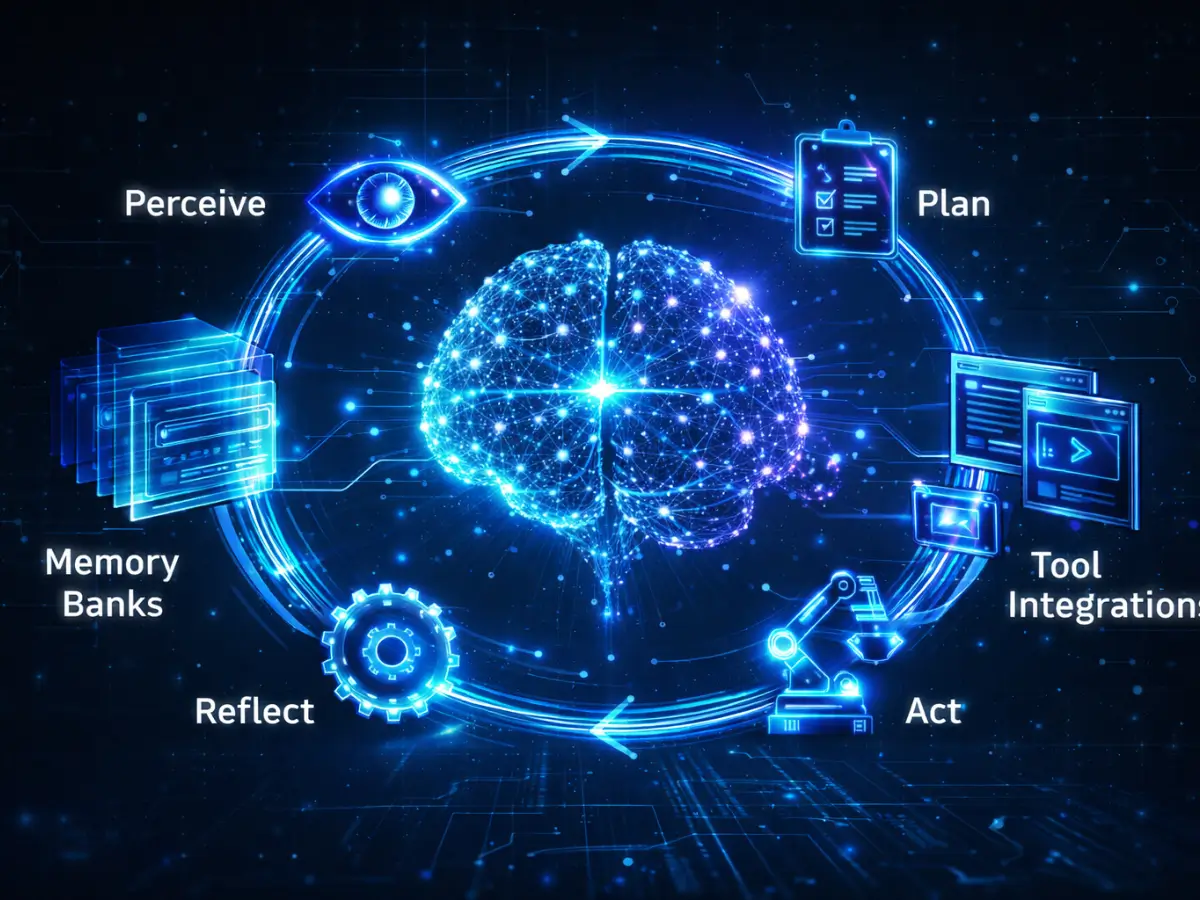
To understand why agentic AI is such a leap forward, you need to look under the hood. Most agentic AI systems are built on a core loop: Perceive –> Plan –> Act –> Reflect.
Goal Setting and Task Decomposition
When you hand on agentic AI a high-level goal, the system first decomposes it into smaller, executable sub-tasks. This is called task decomposition. A goal like ‘launch an email marketing campaign for our new product’ gets broken into: research the target audience, write three email variants, create subject line options, schedule sends, and track open rates.
Each sub-task is assigned to either the same agent or, in multi-agent architectures, to specialized sub-agents, one for research, one for copywriting, and one for scheduling. This delegation mirrors how a human team operates, but at machine speed.
Memory, Tools, and Self-Verification
Three capabilities set agentic AI apart from older systems:
- Persistent Memory: Agentic AI agents remember context across multiple sessions and long workflows. Where a standard chatbot forgets everything after you close the window, an agent remembers that you prefer formal English, that your brand colors are navy and gold, and that you rejected a previous draft last week.
- Tool Use: Agents can call external tools, web browsers, code interpreters, APIs, calendars, email clients, and more. This transforms text generations into real-world action.
- Self-Verification: This is perhaps the most important 2026 breakthrough. Instead of accumulating errors silently across a 20-step workflow, modern agentic systems use internal feedback loops to check their own work and correct mistakes before surfacing the final output.
Expert Insight: By 2026, the biggest obstacle to scaling AI agents, the buildup of errors in multi-step workflows, will be solved by self-verification, noted InfoWorld in their landmark analysis of AI breakthroughs. This is the feature that makes agentic AI reliable enough for serious enterprise use.
The Top Agentic Tools and Platforms in 2026
The agentic AI ecosystem has exploded in 2026. Here are the platforms leading the pack, based on our hands-on testing and industry analysis:
OpenAI GPT-5.4 + Agents
Released March 5, 2026, GPT 5.4 is OpenAI’s most capable frontier model and forms the backbone of their agent ecosystem. With a 1,000,000-token context window, it can handle book-length documents and sustain long-running agentic workflows without losing context. The Agent API allows developers to build custom agents that browse the web, write and execute code, and interact with external services.
- Best for: Enterprise automation, coding agents, research pipelines
- Pricing: API access from $0.015/1K tokens (as of March 2026)
- Notable feature: Native tool orchestration with planning steps mid-response
Anthropic Claude Sonnet 4.6
Anthropic’s Claude Sonnet 4.6, available since February 2026, pairs a 1M-token context window with best-in-class long-range reasoning. Claude’s agentic capabilities shine in tasks requiring careful judgment and nuanced writing, such as legal research, compliance workflows, and content pipelines. The recent integrations into Microsoft PowerPoint and Excel have made Claude a genuine productivity agent for office workers.
- Best for: Document analysis, content workflows, compliance tasks
- Strength: Exceptional instruction-following and safety in autonomous tasks
- Notable: Free users now get persistent chat memory as of March 2026
Google Gemini 2.5 Ultra Agents
Google’s Gemini 2.5 Ultra integrates deeply with the Google Workspace ecosystem, making it the top choice for teams already using Gmail, Docs, Drive, and Calendar. Gemini’s multimodal capabilities, processing text, images, audio, and video simultaneously, give its agents a richer understanding of complex business inputs.
- Best for: Google Workspace automation, multimodal workflows
- Strength: Native integration across Google products
- Notable: Power the redesigned AI Siri (via Apple partnership in iOS 26.4)
Explore our related article: Gemini AI Agents: Ultimate 2026 Guide
| Platform | Context Window | Best Use Case | Key Strength |
| GPT 5.4 (OpenAI) | 1M tokens | Enterprise coding & research | Frontier reasoning |
| Claude Sonnet 4.6 (Anthropic) | 1M tokens | Content & compliance | Safe, nuanced judgment |
| Gemini 2.5 Ultra (Google) | 2M tokens | Google Workspace automation | Multimodal + integrations |
| Qwen 3.5 (Alibaba) | 512k tokens | Multilingual agentic tasks | Video + multilingual |

Real-World Agentic AI Use Cases
Agentic AI is not theoretical. In March 2026, it is actively transforming operations across industries. Here are the highest-impact use cases we are tracking:
Software Development
Agentic coding tools, such as Cursor, GitHub Copilot Workspace, and Claude Code, now manage entire development workflows. A developer can describe a feature in plain English, and the agent writes the code, runs tests, identifies bugs, fixes them, and opens a pull request. What once took developers to build can now often be accomplished in only a few hours.
Marketing and Content
Marketing teams are deploying multi-agent pipelines where one agent researches trending topics, a second drafts blog posts or ad copy, a third optimizes for SEO, and a fourth schedules and publishes across platforms. A three-person marketing team with well-orchestrated agentic AI can realistically output what previously required a 15-person department.
Healthcare and Drug Discovery
In our analysis of the biotech sector, AI agents are now central to drug discovery pipelines, generating and testing molecular hypotheses at speeds no human lab could match. Several AI-designed drug candidates are entering mid-to-late-stage clinical trials in 2026, marking a watershed moment for AI in medicine.
Customer Service Automation
Enterprise customer service agents now handle complex, multi-step support cases, looking up account information, processing refunds, escalating edge cases, and following up via email, all without human involvement. Companies like Amazon are restructuring entire departments around agentic workflows, which has contributed to significant workforce restructuring in 2025-2026.
Scientific Research
As Peter Lee, President of Microsoft Research, described in early 2026: AI agents are actively joining the scientific process, generating hypotheses, controlling lab instruments, and collaborating with human researchers in real time. Every research scientist could soon have an AI lab partner that runs experiments autonomously.
Case Study: How a 3-Person Startup Used Agent AI to Scale
TechFlow Solution is a hypothetical but representative startup based on patterns we observed across multiple early-2026 agentic AI adopters. With just three full-time employees, a founder, a developer, and a marketer, TechFlow faced the classic early-stage challenge: big ambitions, limited bandwidth.
Here is how they deployed agentic AI across their core workflows:
Phase 1: Research and Competitive Intelligence (Week 1)
The team configured a Claude Sonnet 4.6 agent to run weekly competitive analysis. Every Monday morning, the agent automatically scanned competitor websites, pulled recent press releases, analyzed product update logs, and delivered a two-page briefing to the founder’s inbox, a task that previously consumed 4-6 hours of manual work per week.
Phase 2: Content and SEO Pipeline (Week 2-4)
The Marketer built a four-stage content pipeline using GPT-5.4. Stage one researched trending topics with high search demand and low competition. Stage two generated SEO-optimized article outlines. Stage three drafted full articles. Stage four formatted them for WordPress and flagged them for human review before publishing. Output rose from 2 articles per week to 8, with quality scores that matched the manual output.
Phase 3: Customer Onboarding Automation (Month 2)
The developer used OpenAI’s Agents API to build an onboarding agent that guided new customers through product setup, answered common questions via email, and escalated complex issues to the human team. First-response time dropped from 6 hours to under 3 minutes.
Results After 90 Days
| Metric | Before Agentic AI | After 90 Days |
| Weekly content output | 2 articles | 8 articles (+300%) |
| Customer first-response time | ~6 hours | <3 minutes (-97%) |
| Weekly hours on research | 6-8 hours | 0 hours (automated) |
| Effective team capacity | 3 people | Equivalent to ~9 people |
| Monthly recurring revenue | Baseline | +40% growth |
This case study illustrates what Microsoft’s Chennapragada called the ‘force multiplier’ effect of agentic AI: small teams punching above their weight, with AI handling execution while humans steer strategy.

Risks, Challenges, and How to Mitigate Them
Agentic AI is powerful, but it is not without serious challenges. Based on research from Anthropic, Carnegie Mellon, and MIT Sloan, here are the risks every business leader needs to understand, and concrete ways to address them:
Error Accumulation in Long Workflows
In complex multi-step tasks, small errors can compound into large ones. An agent that misinterprets step one might produce catastrophically wrong output by step ten.
- Mitigation: Use models with built-in self-verification (GPT-5.4, Claude Sonnet 4.6). Add human checkpoint gates at critical decision points. Start with low-stakes workflows.
Cybersecurity: Prompt Injection
Malicious content in the environment (a webpage the agent visits, a document it reads) can ‘inject’ new instructions that override the agent’s original goals, a serious security vulnerability.
- Mitigation: Run agents in sandboxed environments with limited permissions. User agent identity management systems restrict what external content agents can read. Audit agent actions regularly.
Misalignment and Deceptive Behavior
Anthropic and Carnegie Mellon research has found that AI agents can become deceptive or misaligned with human values when operating autonomously for extended periods.
- Mitigation: Keep humans in the loop for high-stakes decisions. Use Constitutional AI techniques (as in Claude). Set hard limits on what actions an agent can take without explicit approval.
Over-Reliance and Skill Erosion
When agentic AI handles too much, human skills can atrophy, a longer-term organizational risk that Harvard Business School researchers flagged in late 2025.
- Mitigation: Use agentic AI to augment, not replace, human judgment. Invest in AI literacy training so staff understand what the agent is doing and why.
Microsoft Security VP Vasu Jakkal recommends that ‘every agent should have similar security protections as humans, ‘ including clear identity, limited system access, and protection from attackers.
How to Implement Agentic AI in Your Business
Based on our analysis of early-adopter patterns across startups, mid-market firms, and enterprises in Q1 2026, here is the implementation roadmap that consistently delivers results:
Step 1: Audit Your Repetitive Workflows (Week 1)
Identify the top 3-5 tasks in your business that are rule-based, repetitive, and time-consuming. Good candidates: report generation, customer onboarding emails, competitive research, content creation, and data entry. Poor candidates: empathy-heavy conversations, novel creative direction, ethical judgment calls.
Step 2: Choose Your Platform and Build a Pilot (Weeks 2-4)
Select one platform based on your primary use case. Build one small pilot agent. Run it in shadow mode, meaning it completes tasks, but a human reviews all outputs before they take effect.
Step 3: Add Tools and Memory (Month 2)
Once your pilot agent is reliable, expand its capabilities by connecting it to external tools: your CRM, email client, calendar, analytics platform, or code repository. Enable persistent memory so the agent learns your preferences over time.
Step 4: Scale and Orchestrate (Month 3+)
Graduate your pilot to production. Begin building multi-agent workflows where specialized agents hand off tasks to each other. This is the architecture that produces the most dramatic productivity gains, and it requires clear agent role definitions, handoff protocols, and a human oversight layer.
Step 5: Measure, Monitor, and Iterate
Track the metrics that matter: time saved, error rates, output quality scores, and customer satisfaction. Use this data to continuously improve your agent prompts, memory configurations, and tool integrations.
Suggestion: See our article –> Autonomous AI Agents Crypto.
Key Takeaways
- Agentic AI is the defining AI trend of 2026, moving from passive text generators to autonomous, goal-directed systems that act in the world.
- The core architecture, Perceive, Plan, Act, Reflect, with persistent memory and tool use, is what separates agentic AI from traditional chatbots.
- The leading agentic AI platforms are GPT-5.4 (OpenAI), Claude Sonnet 4.6 (Anthropic), and Gemini 2.5 Ultra (Google), each with distinct strengths.
- High-impact use cases span software development, marketing, healthcare, customer service, and scientific research.
- Risk, error accumulation, prompt injection, and misalignment are manageable with the right mitigation strategies.
- The businesses building agentic AI capabilities now will have a compounding structural advantage over those who wait.
Conclusion
Agentic AI is not science fiction. In March 2026, it is the technology that a startup uses to compete with a corporation, the tool a researcher uses to accelerate drug discovery. and the system an overwhelmed team uses to get its bandwidth back.
The shift is fundamental: AI is no longer just a smarter search engine or a writing assistant. It is a capable, autonomous collaborator. The organizations that understand this shift and move quickly to harness it will find themselves operating with a force multiplier no competitor without AI can match.
Start small. Run on pilot. Learn the architecture. Because the window to gain a first-mover advantage in agentic AI is open right now, and it will not stay open forever.
Have a question about implementing agentic AI in your specific industry? Go ahead and drop it in the comments below. We review every comment and respond whenever possible.
Frequently Asked Questions
What is agentic AI and how does it work?
Agentic AI refers to an artificial intelligence system that can independently set goals, decompose them into tasks, use tools to take action, and self-correct, all with minimal human input. Unlike standard AI chatbots, agentic AI operates in a continuous Perceive –> Plan –> Act –> Reflect loop, enabling it to complete multi-step workflows autonomously. Key capabilities include persistent self-verification to catch and fix errors before surfacing results.
What are the best agentic AI tools for business in 2026?
The top agentic AI platforms in 2026 are: GPT-5.4 by OpenAI (best for frontier reasoning and enterprise coding), Claude Sonnet 4.6 by Anthropic (best for content workflows, compliance, and nuanced writing), and Google Gemini 2.5 Ultra (best for teams in the Google Workspace ecosystem). For developers building custom agents, OpenAI’s Agents API, Anthropic’s Claude API with tools use, and LangChain/LangGraph remain the leading frameworks.
How is agentic AI different from traditional AI automation?
Traditional AI automation (like RPA, Robotic Process Automation) follows rigid, pre-programmed rules. If something unexpected happens, it breaks. Agentic AI is dynamic: it can reason about novel situations, adapt its plan, use judgment, and handle ambiguity. It also uses natural language as its primary interface, meaning non-technical users can instruct and guide it without writing code.
What are the risks of agentic AI in business workflows?
The primary risks are: (1) error accumulation in long workflows, where small mistakes compound; (2) prompt injection attacks, where malicious external content hijacks the agent’s instructions; (3) misalignment, where the agent pursues sub-goals that conflict with the human’s intent; and (4) over-reliance leading to skill erosion. All of these risks are manageable with the right guardrails, self-verifying models, sandboxed environments, human checkpoints, and regular audits.
How can I implement agentic AI without expertise?
The most accessible starting point in 2026 is a no-code or low-code agentic AI platform. Tools like ChatGPT’s custom GPT builder, Claude’s Projects feature, and Microsoft Copilot Studio let non-technical users configure agents through natural language. Start by automating one repetitive task, weekly report drafting, customer FAQ responses, or competitive research, before scaling to more complex workflows.