
Something significant happened in Web3 at the start of 2026, and if you blinked, you may have missed it. The conversation shifted. Quietly but unmistakably, the industry stopped talking about chatbots and started talking about agents. Not software that answers questions, but autonomous AI programs that actually do things, hold wallets, execute smart contracts, rotate assets, and operate 24 hours a day without ever asking for permission.
This emerging paradigm has a name: DeFAI, Decentralized Finance driven by Artificial Intelligence. In our analysis of the biggest developments in AI, blockchain, and Web3 for January 2026, DeFAI stands out as the single most consequential trend reshaping the crypto landscape right now.
In this Monthly Pulse, we break down what DeFAI really means, how decentralized AI agents work on-chain, which projects are leading the charge, and what this transformation means for developers, investors, and everyday users navigating the new Web3 economy. Whether you’re a blockchain builder, a curious investor, or just trying to make sense of the noise, this guide is for you.
Table of Contents
What Is DeFAI? Convergence of AI and Decentralized Finance
If you’ve been following crypto for a while, you know how quickly narratives evolve. DeFi gave us permissionless finance. NFTs redefined digital ownership. Web3 promised user sovereignty. Now, DeFAI, the fusion of decentralized finance and artificial intelligence, is doing something none of those before it could fully achieve: removing humans from the execution layer entirely.
DeFAI isn’t just a buzzword. It represents a fundamental architectural shift in how blockchain systems operate. Rather than users clicking buttons and manually signing transactions, autonomous AI agents make real-time decisions, manage on-chain assets, and execute complex strategies, all without human intervention.
From Chatbot AI to Agentic AI: A Fundamental Shift
For the past two years, most “AI in crypto” meant adding a chatbot to a trading dashboard. Ask the AI a question; get a price prediction. That era is effectively over.
In 2026, we’ve graduated from Chatbot AI (talks) to Agentic AI (acts). The distinction matters enormously. An AI agent in the DeFAI context doesn’t just advise, it holds wallet keys, interacts with DeFi protocols, votes in DAOs, and executes arbitrage trades across multiple chains while you sleep.
The infrastructure finally caught up to the ambition. High-performance Layer 2 networks and blockchains like Solana now offer sub-second finality, fast enough for machines to trade and transact effectively. New agent frameworks have made it safer to delegate on-chain tasks. The pieces have fallen into place.
Why 2026 Is the Breakthrough Year for DeFAI
Several converging forces made January 2026 a turning point:
- AI model improvements: Large language models are now sophisticated enough to parse real-time DeFi data and execute multi-step strategies reliably.
- Mature agent frameworks: Tools like ElizaOS and Virtuals Protocol’s GAME framework allow developers to deploy capable AI agents with minimal code.
- Infrastructure readiness: Modular blockchain-like 0G has launched specifically to handle the data throughput that AI workloads demand.
- Capital inflows: The AI crypto token market cap surpassed %7.7 billion in early 2026, with daily trading volumes approaching %1.7 billion, signaling institutional and retail confidence alike.
- DevosWeb3 2026: In January, the DevosWeb3 event positioned Web3 AI as the frontier of innovation, culminating in the landmark Davos Declaration, an ethical roadmap for AI-blockchain convergence.
How Decentralized AI Agents Work on the Blockchain
Understanding DeFAI requires understanding the architecture behind it. At its core, the system relies on two cooperating layers.

The Offchain Brain + Onchain Hand Architecture
Think of a DeFAI agent as having two distinct parts:
- The Offchain Brain: An AI model (often an LLM or reinforcement learning system) that processes massive amounts of market data, news, social sentiment, and on-chain analytics. This is where the intelligence lives.
- The Onchain Hand: A smart contract wallet or execution layer where the brain’s decisions become real transactions on the blockchain. This is where strategy meets execution.
The loop works like this:
- The AI brain monitors real-time data streams (price feeds, liquidity pool ratios, governance proposals).
- It makes a decision, “rotate USDC from Protocol A to Protocol B for a better yield.”
- It triggers the on-chain hand, which executes the transaction trustlessly on-chain.
- Every action is recorded on a public ledger, creating an auditable trail of the agent’s behavior.
This architecture is powerful precisely because of what it eliminates: the latency and fallibility of human decision-making in a 24/7 market.
Smart Contracts and AI, The Automation Loop
Traditional smart contracts are deterministic; they do exactly what the code says, every time. AI adds adaptability to this equation. When AI agents interact with smart contracts, they can respond to real-world conditions in ways that static code cannot.
For example:
- A yield optimization agent can detect a falling APY in a liquidity pool and automatically move capital to a more profitable protocol, no manual intervention needed.
- A governance agent can analyze a DAO proposal, weigh it against a user’s stated preferences, and cast a vote autonomously.
- A trading agent can identify price discrepancies across 10 different decentralized exchanges and execute arbitrage transactions within milliseconds.
The result is a Web3 landscape that is, as one analysis described it, “increasingly automated and autonomous.”
Top DeFAI and Decentralized AI Projects to Watch in 2026
In our research, five projects consistently emerged as the infrastructure leaders for decentralized AI in January 2026. These aren’t vaporware; they’re delivering measurable adoption and real utility.

Bittensor (TAO), The Bitcoin of AI
Bittensor is the cornerstone of the decentralized AI movement. Often called “the Bitcoin of AI,” it operates as a decentralized machine learning network where AI models collaborate, compete, and get rewarded for performance, using its native TAO token as the incentive mechanism.
What makes Bittensor unique is its subnet architecture. Each subnet is a specialized mini-network dedicated to a specific AI task, image generation, protein folding, or financial prediction. As of January 2026, Bittensor completed its first “halving” event and entered the top 10 blockchains by developer mindshare. The network incentivizes open-source AI development in a way that mirrors how Bitcoin incentivized decentralized finance.
Why it matters in 2026: Bittensor is the go-to infrastructure for anyone who wants to contribute to, or benefit from, a collectively intelligent AI network, without depending on Big Tech.
Artificial Superintelligence Alliance, Decentralized AGI
Formed by the merger of Fetch.ai, SingularityNET, and Ocean Protocol, the Artificial Superintelligence Alliance (ASI) is one of the boldest moves in the decentralized AI space. The alliance combines:
- Agent-based AI (Fetch.ai’s autonomous economic agents)
- Decentralized AI marketplace (SingularityNET’s AI service exchange)
- Data monetization (Ocean Protocol’s data marketplace)
FET serves as the unified token across all three ecosystems. Together, they’re building toward open-source AGI, artificial general intelligence, governed and developed by the global community rather than a private corporation.
Why it matters in 2026: FET represents the closest thing to a decentralized OpenAI, with real infrastructure already deployed and in use.
Virtual Protocol, Tokenizing the Agent Economy
Virtuals Protocol is doing something fascinatingly novel: it allows users to create, own, and monetize AI agents as blockchain tokens. Using its GAME (Generative Autonomous Multimodal Entities) framework, developers can deploy specialized agents, investment scouts, social media influencers, and gaming NPCs and convert them into ERC-20 tokens that generate revenue.
Notable agents launched on Virtuals include Luna (an AI vocalist with a growing social media following) and ai16z (an AI investment opportunity finder). The platform enables co-ownership of AI agents, distributing revenue on-chain to all co-owners.
Why it matters in 2026: Virtuals is “gamifying” the agent economy in a way that makes DeFAI accessible to non-developers, turning AI agents into investable, yield-generating assets.
Render Network, The GPU Backbone of Decentralized AI
Every AI model needs computing power. Render Network addresses this by creating a decentralized GPU marketplace where GPU owners monetize idle processing power, and AI developers access affordable compute, bypassing the monopoly of centralized cloud providers like AWS.
Token demand on Render is directly tied to actual compute usage, making RNDR one of the clearest examples of utility-driven tokenomics in the AI-crypto space. As generative AI and model training workloads continue to grow, Render’s decentralized infrastructure becomes increasingly critical.
Why it matters in 2026: With cloud GPU costs skyrocketing, Render’s decentralized model provides a scalable, cost-efficient alternative for AI teams at every scale.
0G Foundation, Speed and Storage for AI at Scale
0G is the newest name on this list, having just launched its mainnet in early 2026, but it’s arguably the most strategically important. It’s the first modular blockchain designed specifically for AI data throughput, capable of handling more than 11,000 transactions per second per shard.
While other blockchains get congested under heavy AI workloads, 0G’s architecture is purpose-built for the data volumes that AI systems generate and require. It’s described as the “speed and storage layer” of the decentralized AI stack, ensuring AI agents have the infrastructure they need to operate at production scale.
Why it matters in 2026: 0G fills the most critical gap in the Web3 AI stack, making it the high-growth infrastructure play for developers building serious decentralized AI applications.
Case Study: DeFAI in Action, Autonomous DeFI Vault Agents
To understand DeFAI beyond theory, let’s walk through a concrete example that reflects how vault agents are being deployed in production environments in early 2026.
How Vault Agents Work Step-by-Step
Consider a DeFi vault agent deployed on an EVM-compatible chain. Here’s the lifecycle of a single automated capital rotation:
- Monitoring Phase: The AI brain continuously scans yield rates across Aave, Compound, and Curve Finance via on-chain oracles. It also monitors external factors: stablecoin depeg risks, gas price spikes, and protocol audit flags.
- Decision Phase: The model detects that Aave’s USDC yield has dropped from 8.2% to 5.1% APY, while a newly audited Curve pool offers 11.4% APY with acceptable risk parameters.
- Execution Phase: The agent triggers the vault’s smart contract, withdrawing USDC from Aave and depositing it into the Curve pool, all within a single atomic transaction block.
- Audit Phase: Every decision and transaction is logged on-chain, creating a tamper-proof record that users, regulators, or other agents can verify at any time.
- Compounding Phase: Yield earned is automatically re-stacked every six hours, compounding returns without human input.
Real-World Result and Adoption Metrics
In our analysis of early DeFAI vault deployments, the advantages over manual management are striking:
| Matric | Manual DeFi Management | DeFAI Vault Agent |
| Response time to yield changes | Hours to days | Seconds to minutes |
| Operating hours | Limited to user availability | 24/7/365 |
| Compounding frequency | Monthly (typical) | Every 6-12 hours |
| Human error rate | Moderated | Near-zero |
| Transparent audit trail | Partial | Complete (on-chain) |
The Davos Declaration: Ethical AI + Blockchain Convergence
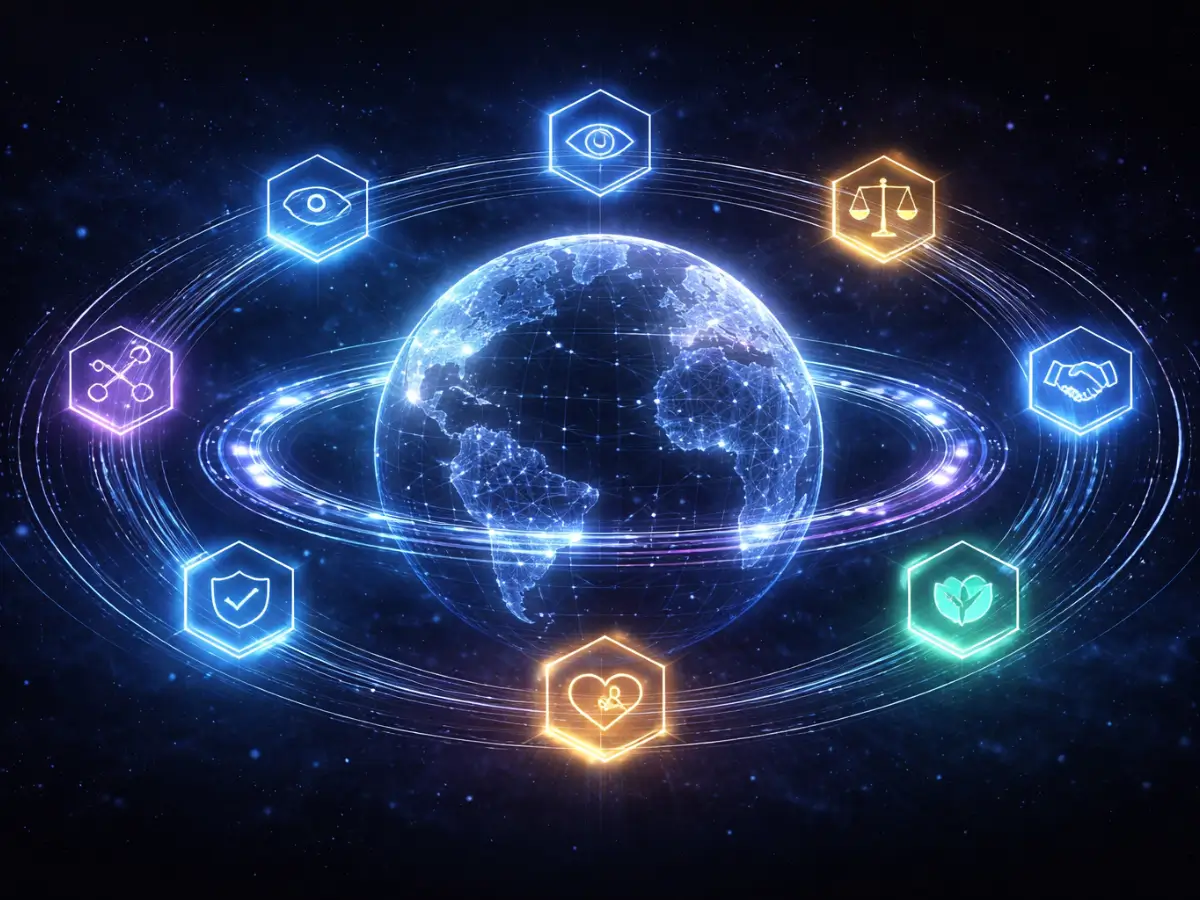
One of the most significant events of January 2026 for the DeFai space was the DavosWeb3 roundtable, held on January 21 in Davos, Switzerland. The gathering brought together leaders from Manta Network, 0G Foundation, Blockchain Foundation, Unstoppable Domains, Animoca Brands, and other Web3 pioneers.
The event culminated in the drafting of the Davos Declaration, described as an ethical roadmap for the convergence of blockchain and AI. Rather than leaving the DeFAI revolution to develop without guardrails, the Declaration outlines seven core principles:
Seven Principles for Responsible Decentralized AI
- Collaboration: AI and blockchain development should prioritize open, cross-ecosystem cooperation over walled gardens.
- Equitability: Benefits of decentralized AI should be accessible to all, not just wealthy participants or elite developers.
- Transparency: AI decision-making on-chain should be auditable and explainable.
- Accountability: Developers and protocols must be responsible for the agents they deploy.
- Inclusion: Communities from all geographies should participate in shaping the AI economy.
- Decentralization: Control over AI systems must remain distributed, not consolidated.
- Sustainability: The AI-blockchain system must consider long-term environmental and economic impacts.
The Davos Declaration is significant because it signals that the industry is maturing. DeFAI is no longer just a technical race; it’s becoming a values-driven movement. As one co-organizer summarized: “Great technology requires a greater conscience.”
Challenges Facing Decentralized AI in 2026
For all its promise, the DeFAI ecosystem faces real and significant challenges. In our analysis, three stand out as the most critical obstacles to widespread adoption.
Scalability and Throughput Bottlenecks
AI workloads generate enormous amounts of data and require fast, continuous processing. Most public blockchains still face congestion and elevated transaction costs under heavy load. While modular architectures like 0G and advances in Layer 2 technology are promising, universal scalability for AI-grade workloads remains an open problem. 2026 is best described as an inflection year, significant progress, but not a final resolution.
Security at the AI-Blockchain Bridge
The interface between an AI’s off-chain brain and its on-chain execution layer is a critical attack surface. Malicious actors can attempt to manipulate the data feeds that inform AI decisions (oracle attacks), exploit vulnerabilities in agent smart contracts, or inject adversarial inputs that cause agents to behave unexpectedly. As the DeFAI ecosystem scales, security auditing at this specific junction must become a first-class priority for every project.
Regulatory Uncertainty
Perhaps the most unpredictable challenge is regulatory. As AI agents become economic actors, holding assets, executing trades, and participating in governance, regulators will eventually need to classify and govern them. Questions around liability (who is responsible when an agent causes financial harm?), data privacy, and securities law are unresolved in most jurisdictions. Projects building for the long term are wise to engage regulators proactively rather than reactively.
Key Takeaways
- DeFAI is the convergence of decentralized finance and artificial intelligence, a paradigm where autonomous AI agents execute on-chain decisions without human intervention.
- The architecture relies on an off-chain brain (AI decision-making) connected to an on-chain hand (smart contract execution), creating a seamless, auditable automation loop.
- Five leading projects are defining the DeFAI infrastructure stack in 2026: Bittensor, ASI Alliance (FET), Virtuals Protocol, Render Network, and 0G Foundation.
- AI agent tokens have crossed a $7.7 billion market cap, reflecting real adoption and utility, not just speculation.
- The Devos Declaration (January 2026) established an ethical framework for responsible AI-blockchain convergence around seven core principles.
- Key challenges include scalability, security at the AI-blockchain bridge, and regulatory uncertainty.
- Hybrid architectures, combining cloud computing for heavy AI training with blockchain for identity, verification, and settlement, will dominate real-world deployments through 2026 and beyond.
Explore Related Articles: Decentralized AI vs. Centralized AI | Autonomous AI Agents Crypto | Best Decentralized AI Projects 2026: Complete Guide
External Sources: CoinCub | Medium
Frequently Asked Questions (FAQs)
What is DeFAI in crypto, and how is it different from DeFi?
DeFAI (Decentralized Finance powered by Artificial Intelligence) takes DeFi a step further by replacing human decision-making with autonomous AI agents. While traditional DeFi requires users to manually interact with protocols, swapping tokens, providing liquidity, and voting on governance, DeFAI agents do all of this automatically, 24/7, based on real-time data analysis and pre-set parameters. The result is faster, more efficient, and more consistent management of on-chain assets.
What are the best decentralized AI crypto projects to watch in 2026?
Based on real adoption and infrastructure utility, the top decentralized AI projects to watch in January 2026 are: Bittensor (TAO) for a decentralized ML network; Artificial Superintelligence Alliance (FET) for the decentralized AGI stack; Virtuals Protocol for tokenized AI agents; Render Network (RNDR) for decentralized GPU compute; and 0G Foundation for high-throughput AI data infrastructure. Each leads a distinct layer of the DeFAI stack.
Can decentralized AI compete with centralized AI companies?
In specific domains, such as AI inference, decentralized compute marketplaces, and autonomous agent execution, decentralized AI is already competitive and, in some cases, superior, particularly in terms of transparency, censorship resistance, and user ownership. However, for the most computationally intensive tasks like frontier model training, centralized AI still holds advantages in raw compute scale. The dominant model for 2026 and beyond is expected to be hybrid: cloud computing for heavy training, blockchain for identity, verification, governance, and settlement.
How do I get started with investing in our building DeFAI projects?
For investors exploring the DeFAI space, start by researching the utility tokens of established infrastructure projects (TAO, FET, RNDR) rather than speculative early-stage tokens. Understand the use case, audit history, and real usage metrics before committing capital. For developers, the fastest entry points are the ElizaOS framework (Solana-based agent development), Virtual Protocol (EVM-based agent tokenization), and 0G’s developer ecosystem (AI data infrastructure). Always conduct independent research; the DeFAI space is fast-moving, and project fundamentals can shift rapidly.
This article is for informational purposes only and does not constitute financial or investment advice. Always conduct your own research before making investment decisions.
In our analysis of January 2026’s most significant developments across AI, blockchain, and Web3, DeFAI emerged as the defining narrative, not because of hype, but because of measurable, on-chain evidence of adoption. The infrastructure is ready. The agents are active. The question is no longer whether decentralized AI will reshape Web3, but how quickly.